A cracked seawall cap on a Rio Vista canal lot and a cracked seawall cap on a Seven Isles canal lot can carry two completely different price tags, even when the damage looks identical from the dock. The number that decides which one you get isn't the size of the crack. It's the percentage of the wall's linear footage the repair covers. Broward County's resiliency code treats any single repair that reaches half a seawall's length, or half its replacement cost, as a substantial repair, which means the whole wall, not just the damaged section, has to meet standards the property never had to meet before. A diver's report showing deterioration along 55 feet of a 100-foot wall doesn't call for patching 55 feet. It calls for rebuilding the entire run to a new code, because that number sits on the wrong side of a threshold most listings never mention.
The Line Between a Patch and a Rebuild
Fort Lauderdale's own seawall guidelines fold in this substantial-repair definition directly. Once a permitted repair crosses that halfway mark, whichever measure trips first, length or cost, the entire wall has to meet the city's newer height standards: at least 4 feet above sea level by 2035, rising to 5 feet by 2050. A homeowner who budgets for a section repair can find out mid-project that the code no longer sees a section. It sees the whole wall, and the whole wall now has to clear a bar that didn't exist when the original seawall went in.
This is the piece of due diligence that separates a manageable project from an open-ended one. Two properties with the same visible damage can land on opposite sides of that line depending on how much of the wall an engineer flags, and the flag comes from a report most buyers never see until after they've already gone under contract.
Who Actually Owns the Wall
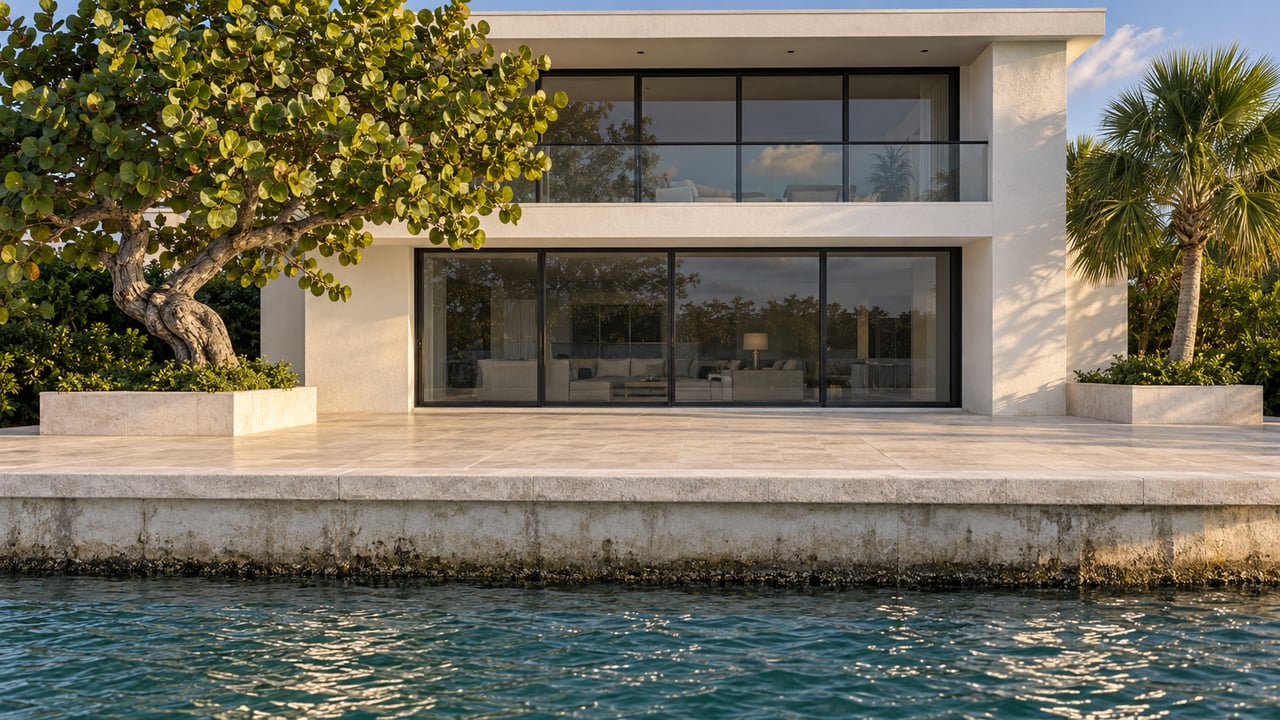
Fort Lauderdale earns its nickname, the Venice of America, from roughly 200 miles of seawalls threading through the city, and the majority of that footage belongs to private property owners rather than the city itself. That private seawall runs behind lots in canal neighborhoods including Rio Vista, Las Olas Isles, Seven Isles, Coral Ridge, Harbor Beach, Idlewyld, Middle River and Tarpon River.
What Crossing the Line Actually Costs
Full seawall replacement in Fort Lauderdale has been estimated at $1,200 to $2,000 per linear foot, a range that reflects the saltwater canal engineering and stricter local review the city requires. A 100-foot wall at that rate lands somewhere between $120,000 and $200,000, a very different number than a routine repair on the same stretch of wall.
| Scope of work | Typical cost | What triggers it |
|---|---|---|
| Routine crack sealing or joint repair | A few thousand dollars for an average wall | Cosmetic deterioration, minor voids |
| Section repair under the 50 percent threshold | Tens of thousands, scaled to length | Localized panel or cap damage |
| Full replacement to current height code | $120,000 to $200,000 for a 100-foot wall in Fort Lauderdale | Repair scope crosses 50 percent of length or cost |
| Professional inspection before any of the above | $330 to $495 for up to 100 feet, per ACI Inspections | Standard pre-purchase or pre-listing diligence |
The inspection is the cheapest item on that table by a wide margin, and it's the one that tells a buyer or seller which of the other three rows they're actually looking at.
The Idlewyld Exception and Other Details a Standard Inspection Won't Catch
Not every canal lot in the city plays by the same rulebook. Certain platted lots in Idlewyld are exempt from Fort Lauderdale's dock permit requirement entirely, a carryover tied to the neighborhood's original recorded plat and a 1964 legal decision. Most other waterfront owners in the city operate under Section 8-144 of the code, which grants dock permits for an initial five-year term with administrative renewal required every five years after, and gives the permit holder 90 days once notified to file for that renewal. A lapsed permit is the kind of detail that doesn't show up on a standard home inspection.
As Breezy Permits notes, some Broward canals are bordered by land that's technically a public right-of-way rather than the owner's private property. When a seawall sits on that strip, repairing it requires a right-of-way or private-use permit stacked on top of the standard building permit, which adds time and paperwork to a project that looks, from the yard, like an ordinary repair.
What the 2026 Permit Change Doesn't Fix
Fort Lauderdale's new permit exemption, effective July 1, 2026, lets owners of eligible single-family homes skip permitting for certain cosmetic, nonstructural work under $7,500. It's a real convenience for a lot of small residential projects, but the exemption explicitly excludes flood-hazard-area work, which is exactly where seawalls and docks live according to the city's own building department guidance. A cracked cap or a leaning panel still goes through full permitting no matter how small the invoice looks, and assuming otherwise is an easy way to start a project on the wrong footing.
Before You Write or Accept an Offer on Fort Lauderdale Waterfront
- Ask for the actual engineer's inspection report, not a verbal summary. It should state how many linear feet of the wall are recommended for repair and what percentage of the total that represents.
- If that number sits close to half the wall's length or half its estimated replacement cost, price the deal as if the entire wall needs to meet the current height standard, not just the damaged section.
- Confirm the dock permit's renewal date under Section 8-144 and ask directly whether it's current.
- Check with the city on whether the parcel is one of the exempt Idlewyld lots, or whether the land at the water's edge is a public right-of-way requiring its own separate permit.
- Pull the flood zone designation for the property and get an insurance quote before finalizing a budget. Premiums vary widely depending on the property's elevation and how close the seawall sits to current code.
Frequently Asked Questions
Does a small crack automatically trigger a full seawall replacement? Not on its own. The trigger is the scope of the recommended repair measured against the whole wall, not the size of any single defect. A short section of cracked cap can often be patched on its own terms. The same crack on a wall where an engineer recommends work across more than half its length is a different conversation.
Does homeowners insurance cover seawall failure? Standard homeowner and flood policies are built around the house itself, not marine infrastructure. Seawall repair is typically an out-of-pocket capital expense unless a specific endorsement says otherwise, which is worth confirming directly with an insurance agent rather than assuming.
Is a seawall inspection required to sell a waterfront home in Fort Lauderdale? Lenders and title companies increasingly ask for one during the transaction, and a seller who orders an inspection before listing keeps more control over the number a buyer eventually sees.
If you're weighing a canal-front purchase or preparing to list one in Rio Vista, Seven Isles, or any of Fort Lauderdale's waterway neighborhoods, the seawall report deserves a close read before the rest of the file does. Miami Invest Group can walk through what a given inspection actually means for your offer, your timeline, and your budget. Schedule a consultation before the percentage on that report decides it for you.
This article is general information, not legal, tax or financial advice. Consult a qualified professional about your situation.